
Ferdinando Sarmi (1912 – 1982) was born into an aristocratic Italian family in which it was expected that he would become a lawyer, doctor, or another of the “male professions” in the Italy of his era and social stature. He first followed this path, but while in Rome during the WWII Nazi occupation, he decided to break with family tradition and expectations. As an antifascist, he found refuge in the Vatican walls where he immersed himself in his real passion: art and fashion. His first designs were beautiful flowers on fabric. When the war ended, he abandoned his previous career pursuits and embraced fashion.
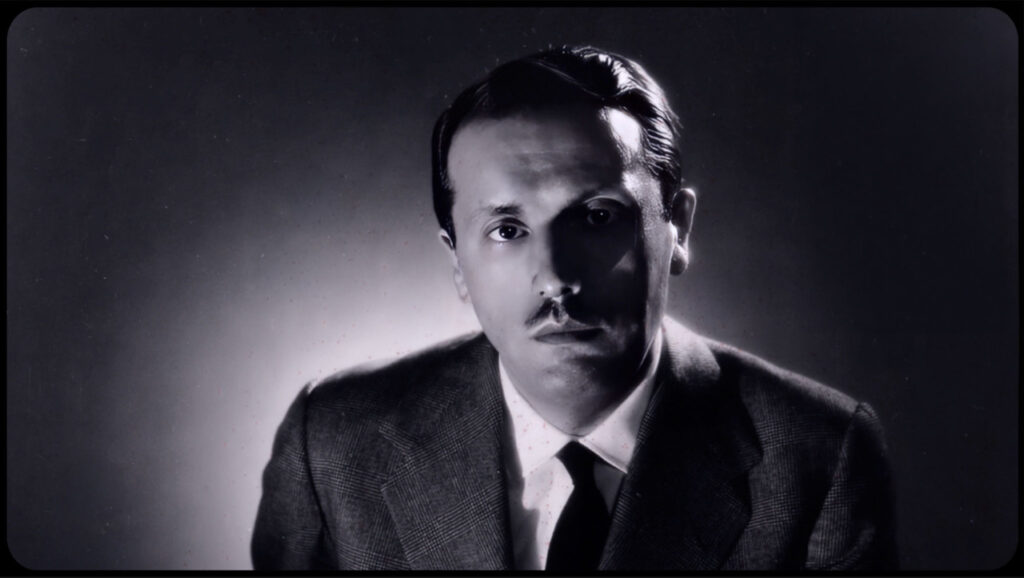
Sarmi worked in important ateliers in Rome until being discovered by famed Italian filmmaker Michelangelo Antonioni who asked him to design the wardrobe for Antonioni’s first feature film Cronaca di un amore (1950). Sarmi was also asked by the filmmaker to play the role of the rich textile industrialist and husband of the female lead character played by rising starlet Lucia Bosè. Sarmi took the role and his styling for the film transformed Lucia Bosè into a diva.
Subsequently, 1951 was a pivotal year for Sarmi. He was called to design a collection for Alberto Fabiani from Rome, a designer that took part in the fashion event of the year, a show organized by Giovanni Battista Giorgini at the Villa Torregiani in Florence. All the major American press outlets descended on Florence after the Paris shows that year, and, as a result, Italian fashion began to be internationally appreciated. The designs were a huge success, especially with the US, and helped to cement the diplomatic, cultural, and economic relationship between Marshall-planned Italy and America.
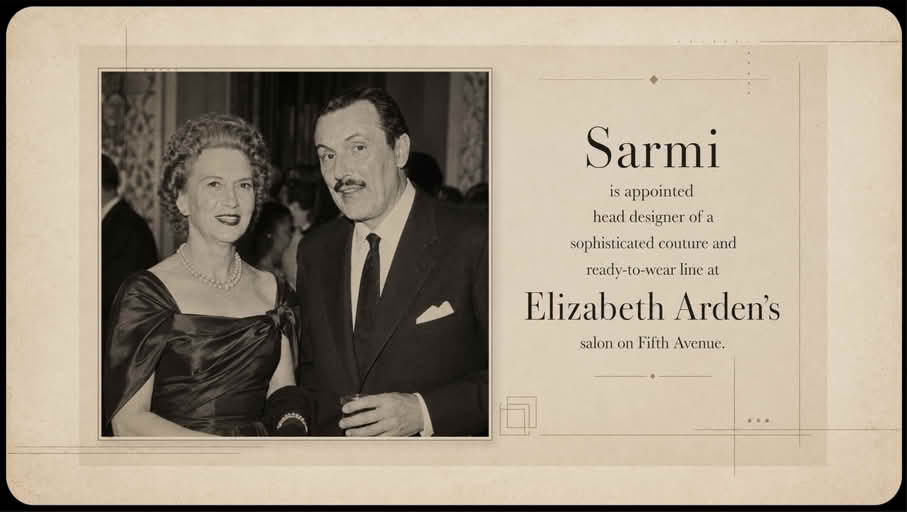
That same year Sarmi received an offer to work as head designer for Elizabeth Arden’s couture line and the sophisticated ready-to-wear collection. He signed his collections as Count Sarmi and he worked with Arden for over seven years before creating his own label in 1959 and dedicating his business to wholesale for the most prestigious American department stores such as I. Magnin & Company, based in San Francisco, CA.
For the first time, this film examines the career of Ferdinando Sarmi, his contributions to New York and American fashion, and his unique role as an ambassador of Italian style in the pivotal post-war American “boom” era.
Ferdinando Sarmi: Untold stories of New York Fashion features interviews with American actor and filmmaker John Turturro, American Costume Designer Donna Zakowska and Italian Costume Designer Massimo Cantini Parrini. The film is based on in-depth archival research in the US within The Costume Institute of The Metropolitan Museum of Art, NY, the Museum of the City of New York, Fashion Institute of Design (FIT), Parsons School of Design, The New York Public Library, and Italy, at The Istituto Luce and the Museum of Costume and Fashion at Palazzo Pitti where Sarmi’s scrapbooks are housed. It is part of a wider research project focusing on the Italian diasporic community’s indelible mark on the fashion industry of New York, of which Italian skill, labor, and creativity shaped the American fashion industry.